Spoilers Ahead: Read at your Own Risk
I loved this book. Though it was written in a format that I've constantly expressed hatred towards, I really feel like there was no way to not like this book. What the author lacked in dialogue he made up for with Charlie's complex yet beautifully written thoughts. So many of the things he's said were relatable. It was almost like talking from confused freshman to another confuse freshman. And the ending was just fantastic. At the beginning you feel like he's talking to someone else, to whoever he's writing to. Or maybe that was just how I felt. Towards the end of the book, however, you realize that you are not reading as someone else that is reading these letters. It feels like you've actually recieved his letter in the mail and opened it, and read it to yourself. And if you put yourself in that mind set, the things that he says about you at the end, about how he's heard you're a good person and that you are kind and that you'd never judge is just touching. I know it's not necessarily directed at you in particular, but I recognized those phrases were specifically put there so that a person who is sturggling with some type of insecurity or whatever they're going through can read that and be extremely content.
I'll admit, the things that Charlie revealed that he went through is horrible. And it also depresses me to see that they were done by a person that he was so close to, a person who was only mentioned briefly but frequently. You would have never assumed until he says that the psychiatrist asked a lot of questions about her and his childhood and all of that. It's only until he's about to do-the-doo with Sam that he slowly begins to fall apart. It's really sad, actually. And it had been so long until it happened, he must have blacked it out in some way. And he blames himself for way too much that's happened, I just wanna give him a hug... Then smack him straight....
Anyway, since the last paragraph was pretty brief on what happened to him, he basically discovers from one of Sam's touches that he had been molested by his Aunt Helen when he was younger, and goes haywire, breaks odwn, is found anked on the couch, and ends up in a hospital. I know, pretty hard core. What makes me kind of sad is that he wasn't mad at her, or anyone for that matter. He said he couldn't blame her, but instead blamed the man who molested her prior to that situation. He said that that was unfortunately who she turned out to be. At one point he says “So, I guess we are who we are for alot of reasons. And maybe we'll never know most of them. But even if we don't have the power to choose where we come from, we can still choose where we go from there. We can still do things. And we can try to feel okay about them,". That quote broke my little heart in two because, I don't know, I think about that a lot, really. It always bothers me when people say that they would change something in their life, or that they wish something that happened to them was taken away. I mean, life is no rainbow and sunshine. We've all got screwed up things happening left and right. While some things can be more severe than others, I think as long as we look at who we are and realize that if you changed even one tiny variable, even if it was not eating that cracker off of the floor when you were little, you wouldn't be the same. While we may not be who we want to be just yet, we've got our whole lives ahead of us. Hell, a majority of you reading this are 14-16? Pfft, you'll be fine.
The book is definitely well worth the read, though if you aren't into heavy stuff (most of which surprised me at first when going on, but didn't really bother me) then you probably should back off. There is drugs, the doing-of-the-do, rape, relationship problems, and just overall drama. If you're not willing to feel, don't read this book. Or just sit down and just don't read. Play with your carpet or something, I don't know.
Friday, April 4, 2014

Ken Kesey's 'One Flew Over the Cuckoo's Nest'- Final Review
This book was definitely one heck of a ride. To read this book effectively you just have to look at everything literally, as well as without any litetral thought at all. That makes no sense I know, but think about it. If you want to understand what's going on to some degree, I'm mostly focusing on Bromden's hallucinations, then you have to take everything figuratively and just as an exceeded fear factor for Bromden's mind. However, if you want to try and comprehend how he must feel in that situation, you must read the hallucinations as if they're actually happening. It's very weird.
Honestly, I don't know if I'm satisfied or not with the ending. It wasn't a happy ending, which kind of satisfies me because it would have honestly been very unrealistic if it had been so simple. However, it didn't feel as fufilling as it should have been. It didn't make me put down the book and say, "wow". It was more like "alright..". But I think for this situation and this plot line, this could have probably been the best ending. (I'm not going too far into detail because I don't want to spoil anything)
Like I said in the last post, all of the character's had their own little satisfying quirks, and they definitely brought humor into the book. The book doesn't typically seem to be serious all that much. Maybe more towards the end, but when McMurphy is around it just seems like a good time. I mean, as much of a good time as you can have in an asylum.
A part that I found interesting in the book was when the narrator, Bromden, of course, says, "Maybe he couldn't understand why we weren't able to laugh yet, but he knew you can't really be strong until you can see a funny side to things. In fact, he worked so hard pointing out the funny side of things that I was wondering a little if maybe he was blind on the other side, if maybe he wasn't able to see what it was that parched laughter deep inside your stomach," (227). I guess this is just kind of an example of how positivity and the will to stay upbeat can work wonders for you and make you stronger, but it kind of stinks for those who finding positivity is practically impossible for. I'm sure Bromden feels some way because McMurphy simply doesn't understand what it is that restricts them from laughing, or smiling, or being as outgoing as he is. They've been beaten down so much that they don't even know how anymore. It's been too long.
Overall, I think this is a pretty good book. I can't say it was amazing or spectacular, or changed my views on anything. But I definitely was introduced to a whole new group of interesting people and in a setting that I'm not really used to. In a way it kind of reminds me of high school.... What a strange comparison...I mean all the rebellion, all the activities that were planned, all the filthy toiletry..... Yup, exactly like high school.
Honestly, I don't know if I'm satisfied or not with the ending. It wasn't a happy ending, which kind of satisfies me because it would have honestly been very unrealistic if it had been so simple. However, it didn't feel as fufilling as it should have been. It didn't make me put down the book and say, "wow". It was more like "alright..". But I think for this situation and this plot line, this could have probably been the best ending. (I'm not going too far into detail because I don't want to spoil anything)
Like I said in the last post, all of the character's had their own little satisfying quirks, and they definitely brought humor into the book. The book doesn't typically seem to be serious all that much. Maybe more towards the end, but when McMurphy is around it just seems like a good time. I mean, as much of a good time as you can have in an asylum.
A part that I found interesting in the book was when the narrator, Bromden, of course, says, "Maybe he couldn't understand why we weren't able to laugh yet, but he knew you can't really be strong until you can see a funny side to things. In fact, he worked so hard pointing out the funny side of things that I was wondering a little if maybe he was blind on the other side, if maybe he wasn't able to see what it was that parched laughter deep inside your stomach," (227). I guess this is just kind of an example of how positivity and the will to stay upbeat can work wonders for you and make you stronger, but it kind of stinks for those who finding positivity is practically impossible for. I'm sure Bromden feels some way because McMurphy simply doesn't understand what it is that restricts them from laughing, or smiling, or being as outgoing as he is. They've been beaten down so much that they don't even know how anymore. It's been too long.
Overall, I think this is a pretty good book. I can't say it was amazing or spectacular, or changed my views on anything. But I definitely was introduced to a whole new group of interesting people and in a setting that I'm not really used to. In a way it kind of reminds me of high school.... What a strange comparison...I mean all the rebellion, all the activities that were planned, all the filthy toiletry..... Yup, exactly like high school.
Stephen Chbosky's 'Perks of Being a Wallflower'- Midway Review
This book is weird.
I like it.
Introduction to Stephen Chbosky's 'Perks of Being a Wallflower'
(Now that the movie's out I swear I can't find the original cover, so here, pretty movie banner)

This is a book I’ve been hearing about left and right, especially with the movie coming out and everything. From what I see, this is a book about a fifteen year old boy named Charlie. While he comes off as a complete ‘nerd’ through his commentary through the novel, though he doesn’t seem to be exaggeratedly freaky, as many characters are. He isn’t teased, he isn’t beat up or anything, and he’s just a regular kid. A regular kid with extra little ticks and a tendency to think too much about things. Earlier in the story, we’re told that his friend died, which is why he seems to be all alone, and a bit more separate from the world. He meets Charlie and Sam, who open him up to this world of misfits and weed-smokers. Though their antics may be socially unaccepted, they seem to be great people, and are extremely accepting of Charlie, despite his struggles and traumas. He’s seen abuse on many levels, from rape of a stranger to his older sister being beaten by her boyfriend, but seems to be holding it all in. It’s hard to kind of determine what’s going to happen in the future of this book. It seems like an almost day-by-day analysis of a normal life that happens to include quotes and events to make you reconsider things. Perhaps the plot will become more apparent later in the story.
This is a book I’ve been hearing about left and right, especially with the movie coming out and everything. From what I see, this is a book about a fifteen year old boy named Charlie. While he comes off as a complete ‘nerd’ through his commentary through the novel, though he doesn’t seem to be exaggeratedly freaky, as many characters are. He isn’t teased, he isn’t beat up or anything, and he’s just a regular kid. A regular kid with extra little ticks and a tendency to think too much about things. Earlier in the story, we’re told that his friend died, which is why he seems to be all alone, and a bit more separate from the world. He meets Charlie and Sam, who open him up to this world of misfits and weed-smokers. Though their antics may be socially unaccepted, they seem to be great people, and are extremely accepting of Charlie, despite his struggles and traumas. He’s seen abuse on many levels, from rape of a stranger to his older sister being beaten by her boyfriend, but seems to be holding it all in. It’s hard to kind of determine what’s going to happen in the future of this book. It seems like an almost day-by-day analysis of a normal life that happens to include quotes and events to make you reconsider things. Perhaps the plot will become more apparent later in the story.
Ken Kesey's 'One Flew Over the Cuckoo's Nest'- Midway Review
Excuse my lack of updates. It’s no fun when your kindle is
stolen. Anyway, I happened to find that I’m quite enjoying this book more as a
physical book than a kindle, and I have no idea why. Anyway, though it still
offers a lack of description and only occasional quotes, most of which are
embedded in the descriptions, I find that I tend to enjoy all of the character’s
quirks. Billy’s constant stream of stuttering, McMurphy’s sass, and I tend to
even enjoy being delved in the narrator, ‘Chief’ Bromden’s insanity flashes
which he calls the fog.
or a while I took everything he said very literally, then I
kind of realized that it was all hallucinations and it made A LOT more sense. Bromden
always talks about this ‘fog’ that he hides in sometimes that stops him from
getting hurt. He says “Nobody complains about the fog, I know why, now: as bad
as it is, you can slip back in it and feel safe. That’s what McMurphy can’t
understand, us wanting to be safe. He keeps trying to drag us out of the fog,
out into the open where we’d be easy to get at,” (123). It seems like when they
go on these insanity flips, they aren’t as bothered by the staff of the asylum
to follow procedures in particular and they are excused if they do something
somewhat out of line or don’t respond because they simply are unable to. What I
notice here is that he doesn’t say ‘McMurphy doesn’t understand”, which would
imply he was capable of doing so, but just hasn’t. He said “McMurphy can’t,”.
McMurphy can’t understand because he’s not insane. He will never be in the
situation that they’re in, so when they space off or become distant he can’t
see why. McMurphy tries to get them to open up and be happy when they play
games like poker or monopoly with jokes and other things, and can’t see why
they don’t actually do so. Bromden overall blames the asylum for his ‘fog’,
developing this ‘fog machine’ in his mind. Maybe he’s trying to say that the
hospital is really what’s driving him mad. While on the other hand, McMurphy
brings a little light into the situation and helps the citizens lighten up and
pulls them out of that fog.
I would go into more context with this, but I don’t know how
much it will be stirring the plot and how important it is. All I know is that
McMurphy is practically trying to get the Big Nurse to flip her lid. She did it
once already, and after a bit it seemed like his antics were calming down when
he realized that she’d probably extend his time at the hospital. Then,
SURPRISE, he just screwed her over again. I kind of feel bad for her, having to
deal with all this. However, I gotta stick to that protagonist side. Can’t
waver too much. She’s being made out to be such a bad guy too so to keep things
simple for me, I’m just gonna hang around McMurphy’s side (though it seems like
the poor girl’s just doing her job).
Wednesday, March 26, 2014
Introduction to Ken Kesey's 'One Flew Over the Cuckoo's Nest'
It's taken me quite a bit to decide on a classic book, but I've decided to take my time to read One Flew Over the Cuckoo's Nest by Ken Kesey. I read the sample, and frankly, I have no idea what's going on. From what I comprehend there's a mental ward, a group of black boys who do this person called the Big Nurse's bidding in the mental ward, and some weird stuff happens from the Big Nurse growing really big and beating up the black boys (don't get me wrong, they're really called this in the book) and some very exaggeratedly cruel punishments (That I have now confirmed are hallucinations by the narrator) done to the misbehaving patients in this hospital. We're introduced to this man called McMurphy, and from the description of the story in amazon, he'll turn the hospital upside down. I recognize that I have an unreliable narrator, and that may not be the best thing for me, but I can handle it. Though the book does not offer as much dialogue as I would prefer, I hope it can prove me wrong on my opinion on the fact these types of books (typically older, classics) lack the key to make me emotionally connected to characters in any way, due to their lack of dialogue and over-explanations.
Wednesday, March 19, 2014
Michael Schofield's 'January First'- Final Review
This was an AMAZING nonfiction book. THe way it is written is almost in a story-type format that makes you feel more engaged opposed to facts being thrown at you. However, I do occasionally question how accurate and exact all of his quotations and descriptions of things may be, but I'm sure they were put as accurately as he remembers. Schofield shares with us his thoughts, his worries, his determination, his fear, and is even willing to include his major faults. Though a lot of things that he thinks about Susan at the time, and that Susan did were negative, he doesn't fail to include details that may make him, or Susan look bad. Their struggle is definitely evident throughout thes tory, and there were even portions that made me tear up. Janni (It's actually spelled Jani now, I found out. After having a friend in the hospital named Dani, she changed it, but I'll continue to write Janni for now since it's what I'm used to) and her parents have to go through so much, and to be introduced to the feelings of a father who is incapable of doing anything to truly help Janni, the hopelessness is apparent on so many different levels. Janni screams, Janni cries, Janni tries to kill herself, Janni tries to hurt other things, Janni's disassociating from reality, and no matter what they do, Michael has to face the fact that there is nothing he can truly do to help his little girl. While Janni is still struggling with her hallucinations, which will never truly go away, she's definitely improving with the help of animal therapy. She takes care of animals from reptiles to horses in order to help calm her outbreaks and other things.
One significant thing in the story that I noticed was the mention of eyes. Schofield talks about how Janni changes depending on her eyes, saying "I've had a lot of experience holding Janni down to keep her from hitting or kicking Bodhi, so I've had the opportunity to look Janni in the eyes a lot. When I do, I don't see them looking back at me. They look blind, like the entire world has disappeared. I have a photo of Janni that I use as the desktop image on our computer... Every time I boot up the computer, Janni's eyes appear, looking right at me. There is warmth in them along with a simple look of happiness. For three years I have been hoping to see those eyes again" (Schofield 100). I feel extremely bad for Janni's father because he's tried so hard to make her happy, but has unfortunately gotten so little in return. I'm not saying that it's Janni's fault or anything, it's just an extremely fortunate happening, to never be able to see your daughter TRULY happy. He only sees her suffer almost every day, to the point that it makes her almost suicidal.
I believe that this is an extremely good book, adn that if you have any interest in psychiatry or psychosis of any time, this would be a really good book to read. It's inspiring, and it almost reminds you, if you're a parent (I'm not, but if I was I'm sure this book would butcher my heart right about now) you'd probably learn a few things from this book. Never giving up, making your kids your number one priority, and that sacrifices must be made for the well being of your kids, not you.
Links:
If you want to continue following Jani's story or contact Michael Schofield, you can go to www.janifoundation.org
Jani and Oprah Winfrey- https://www.youtube.com/watch?v=dAWkZguGD7s
- This is pretty simple to explain. Just a mini story on Oprah about Jani's situation and an overall explanation of what is going on presently. The story took place when Jani was six, so this is more of an update on what's happening.
A random song I found written about Jani: https://www.youtube.com/watch?v=7Q4ZR_Bye_4
- The song is called 'Calalini'. It's written from the perspective of Jani (not actually written by her, of course) and her troubles with her hallucinations. This wasn't made by her family or anything, more of a 'fan-made' thing. It's also a Vocaloid, so it's hard to understand sometimes. These are computer generated voices that are made to make songs. If you're not into that, it's fine. I just stumbled upon it and thought it'd be cool to share.
One significant thing in the story that I noticed was the mention of eyes. Schofield talks about how Janni changes depending on her eyes, saying "I've had a lot of experience holding Janni down to keep her from hitting or kicking Bodhi, so I've had the opportunity to look Janni in the eyes a lot. When I do, I don't see them looking back at me. They look blind, like the entire world has disappeared. I have a photo of Janni that I use as the desktop image on our computer... Every time I boot up the computer, Janni's eyes appear, looking right at me. There is warmth in them along with a simple look of happiness. For three years I have been hoping to see those eyes again" (Schofield 100). I feel extremely bad for Janni's father because he's tried so hard to make her happy, but has unfortunately gotten so little in return. I'm not saying that it's Janni's fault or anything, it's just an extremely fortunate happening, to never be able to see your daughter TRULY happy. He only sees her suffer almost every day, to the point that it makes her almost suicidal.
I believe that this is an extremely good book, adn that if you have any interest in psychiatry or psychosis of any time, this would be a really good book to read. It's inspiring, and it almost reminds you, if you're a parent (I'm not, but if I was I'm sure this book would butcher my heart right about now) you'd probably learn a few things from this book. Never giving up, making your kids your number one priority, and that sacrifices must be made for the well being of your kids, not you.
Links:
If you want to continue following Jani's story or contact Michael Schofield, you can go to www.janifoundation.org
Jani and Oprah Winfrey- https://www.youtube.com/watch?v=dAWkZguGD7s
- This is pretty simple to explain. Just a mini story on Oprah about Jani's situation and an overall explanation of what is going on presently. The story took place when Jani was six, so this is more of an update on what's happening.
A random song I found written about Jani: https://www.youtube.com/watch?v=7Q4ZR_Bye_4
- The song is called 'Calalini'. It's written from the perspective of Jani (not actually written by her, of course) and her troubles with her hallucinations. This wasn't made by her family or anything, more of a 'fan-made' thing. It's also a Vocaloid, so it's hard to understand sometimes. These are computer generated voices that are made to make songs. If you're not into that, it's fine. I just stumbled upon it and thought it'd be cool to share.
Monday, March 17, 2014
Michael Schofield's 'January First'- Midway Review
Halfway
through the book, nothing much is getting better for Janni and her family. At
the beginning they don’t recognize that her daughter may have Schizophrenia,
and that her imaginary friends are actual hallucinations. From what I see, her
father, Michael, is the more understanding parent. He doesn’t attempt to force
her to forget about her ‘friends’, he tries to engage her and take care of her
and support her when she’s good. Susan, the mother, on the other hand, I dislike.
Susan practically gives up on Janni. Every time she struggles with her
moderately, she calls Michael and complains, then criticizes Michael’s actions
when he attempts to help. She admits Janni to a mental hospital more than twice
without Michael’s agreement (though they barely did anything except give her random injections when she spazzed, and at one point even leaves her to run naked
around a hospital, and just says “’I’m done. I’m tired of doing this alone. Let
her run naked through the halls. They need to see what we deal with every day.
Then maybe they’ll get off their asses and get a psychiatrist down here’”
(Schofield 130). NO, you INCOMPETENT MAGGOT. Get up and go take care of your
child and actually act like you’re a good mom. Oh nooooo, you’re
overwheeeeeeelmed. I get it, that sucks, but grow a pair and take care of your
freakin’ child. She came out of YOU for god sakes. I don’t care if she’s a bit
insane, it’s your responsibility and while it may be something out of your
hands, you take care of her like any parent should. I could parent her better
than you. You little- anyway… In a bit more of a summary, poor Michael has been
accused of molesting Janni by an unnamed source because there’s some privacy law
and I hate those laws honestly. If you’re gonna put in a stupid claim, you
should probably have a stupid person to back it up. And maybe I’m just biased,
but that’s just my opinion. I guess in some situations that’d be good, but the
person’s normally gonna get arrested for the claim anyway so it wouldn’t
matter. Besides the point, Janni’s in first grade now, and that’s as far as I’ve
gotten. I really hope Susan steps up her game, Michael gets a little bit of his
enthusiasm back and a little bit more hope, and I hope Janni doesn’t kill Bodhi
by the time the book ends.
Thursday, March 13, 2014
Introduction To Michael Schofield's 'January First: A Child's Descent into Madness and Her Father's Struggle to Save Her'

So, for my nonfiction book, I didn't want to stick myself into something that would bore me, or make me want to give up instantly just because of all the information. When I saw this title in the Kindle Store, I was instantly intrigued. Nah, I'm not a sadist that's into a child's craziness and their parent's struggles but it seems pretty cool. So basically, this is written from the point of view of Michael Schofield, who is the father of the focus of the story. Janni Schofield is to the right of the picture above. The story starts when she is merely a toddler. A one year old who is able to form mere sentences, and eventually grows to be a four year old with the intelligence of a ten or eleven year old. However, these 'imaginary friends' that she has are NOT imaginary friends. They are hallucinations of her later diagnosed schizophrenia. Though she used to be much more open, she is now closed out from the outside world. She has trouble making friends and closes out other children. Her hallucinations are of animals, such as rats named after the days of the week, a cat named 400, and many other creatures, all coming from a place that Janni calls 'Callilini'. While this used to seem innocent, according to Janni, they all tell her to do bad things. From hurting her younger brother or her parents to to kill herself by jumping out of a hospital window. Since this is a nonfiction story, I don't really know what to assume. There isn't exactly 'foreshadowing' in nonfiction books, so its all up to reality for me to find out what's happening. I definitely think that Janni will be hospitalized from time to time, since her violence is getting out of control, attacking her parents, her brother, anything. She's already seeing a therapist from where I've read. I really do hope the best for her parents and Janni. I've seen the results of what serious schizophrenia can do to a person, and since there's no cure for it, the dangers could be endless.
Tuesday, March 11, 2014
Stephen King's 'The Shining' - Final Review
Warning: Spoilers Ahead
Alright, I’m going to be honest. This book wasn’t really as amazing as
everyone was making it out to be. The plot was great, but I think could have
been expressed MUCH better than the way this book did. I’m going to be honest,
I don’t have a weak stomach. So describing to me the disturbing murder or
assault of a random character won’t bother me. It simply won’t especially in a
book. In a movie, maybe I’ll be a little grossed out like “Why is their leg
turned like that? What’s wrong with their ribs?” but I don’t think I’d actually
care. Authors who want to impress all readers, gore loving or sensitive, need
to add in something extra.
There are occasions where the scare factors just make me want to die
laughing, too. There are points in this story where I would wonder what this
story is even about. Voices from masquerades, moving hedge animals, sassy
demons that possess the residents’ head. There has to be my favorite, though.
At the first sentence I kind of got creeped out, humans on all fours can make
you prepare for the worst because you think of exorcist type of stuff. Instead,
this is what I got: “There was a man on all fours halfway down the corridor,
between him in the stairs… The man looked up at him. His eyes were tiny and
red. He was dressed in some sort of silvery, spangled costumes. A dog costume,
Danny realized” (King 335). There was more time spent describing the dog
costume than anything. Nothing threatening in his appearance, nothing that will
haunt me in my nightmares. It was a freaking man in a dog costume. It’s safe to
say that I was laughing pretty hard at this point. What are you trying to do,
Mr. King? Is this supposed to be startling? Disturbing? Despite the man’s
apparent insanity and his threat to eat Danny’s private parts, there was
nothing that was actually threatening about this dog-man-thing.
In conclusion, I hate to say it, but Stephen King’s The Shining was not as appealing as I was expecting. The theme
apparently seemed to be that following in the footsteps of those who hurt you
in the past is probably not the smartest idea, the plot, and the backstories of
each character was good. However, the portrayal of the story, the mood, the
scare factor, the dialogue (especially the random rants that you can ignore)
could be developed SO much better. I can sadly say that I was disappointed, and
hopefully my mind will change with another Stephen King book. So far, however,
I’m not impressed.
Sunday, March 9, 2014
Stephen King's 'The Shining' - Midway Review
By the midpoint of the story, you're about 250 pages into the book. The concept is appealing so far, I explained it a bit more in my last post. Basically, continuing from my last post, little Danny has this thing that a man called 'The Shining', which is basically like a psychic ability. Those who have the Shining can see things that have happened or that are to happen. Even though this hasn't been very obvious, I also think it gives you the ability to see ghosts. Danny has this 'imaginary friend' named Tony, who shows him these visions and it seems that while Tony could be a figment of his imagination, it seems more logical for him to be a ghost of some sorts. At the hotel, Danny is tormented with images of blood and brains being splattered on the walls, corpses, and some sort of fire-extinguisher becoming a snake (what) while his father becomes tormented with his desire for alcoholic drinks, passive aggressive anger, and strange hallucinations. And then there's poor Wendy who has to put up with all this crazy stuff that she doesn't even understand, poor girl.
Honestly, I find that the book would be a lot more emotionally investing if there was a bit more dialogue. A majority of the book is just describing what's happening, and giving a bit of insight of the past. Most of the character's apparent dialogue consists off long and droning monologues that you can skip, and the story can be completely the same, or quick bickers in between the characters in which someone says something notably harsh. Though characters do occasionally have a dialogue that teaches us a bit about the character's personality, it is not enough for me to feel emotionally invested into the characters. Though I get some sob stories about their past, how Wendy's sister died and how her mother was a total jerk, how Jack follows his father's path of being an abusive alcoholic, though he hasn't quite beaten his wife in front of his children yet, and then there's Danny who's just suffering from the first-world problems of being a psychic little boy in a horror story. I don't know why, but when I read these, I can't find myself caring. I understand it was cruel, and it was horrible, but I don't actually FEEL anything. That's the problem with most horror stories, I think. Though I love the horror genre, it is extremely difficult to feel pleased or truly scared. If I want to be truly scared in a book, I need to have characters I genuinely care about and frankly, I could care less about Danny, Jack, and Wendy. Honestly, they feel like characters, not people. That's the problem. I can tell that they're just pawns to be placed in a horror story, and while they have well developed yet tragic pasts, what is there to offer me that I should care about them? How about they're witty, cheeky personalities? Their care for anything? The bad about them mostly overpowers the good in them. I suppose that's what is most disappointing about this book so far. These are characters not people. (Also the book has failed to scare me to any extent, though only one book has ever done that so far)
A lot of the most thought provoking things in the book are tied into scenes with Jack suffering some sort of mental breakdown or whatever. Mostly tied to mental states and insanity such as on page 109, when the author states “When you unwittingly stuck your hand into the wasps’ nest, you hadn’t made a covenant with the devil to give up your civilized self with its trapping of love and respect and honor. It just happened to you. Passively, with no say, you ceased to be a creature of the mind and became a creature of the nerve endings; from college-educated man to wailing ape in five easy seconds” (King 109) it seems what he’s saying is that these states where you just break down and do things you regret are not things that you accept. They’re something that took you by surprise and can change you into something that you’re not. I think this part kind of foreshadows that one of the characters in the story are going to go insane. Based off of the behaviors of the characters, it seems that the one that is going to break is going to be Jack.
Though I’m not super impressed yet with the book, I still have high expectations. I hope that it turns around and proves me wrong, or I will be disappointed.
Friday, March 7, 2014
Introduction to Stephen King's 'The Shining'
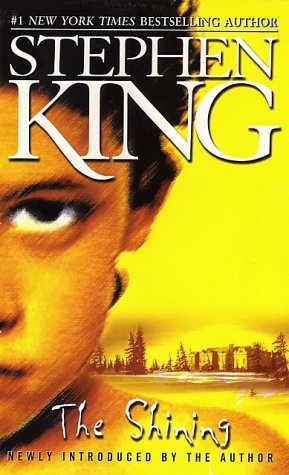
I've never familiarized myself with a Steven King novel, though his name and the stories he's written have been mentioned a lot. He's pretty famous for the horror and suspense genre, and that'd definitely my type of writing style. From what I know about the book, it's set in the 1970's and circulates around the Torrance family. The family consists of Jack Torrance, the father, Danny Torrance, the son, and Winnifred (Wendy) Torrance, the wife. Jack, due to unfortunate events dealing with his alcoholic (and sober) rages, Jack has lost jobs in the past. When he recieves the chance to take on a job at the Overlook Hotel, he accepts and moves him and his family to the hotel. However, Danny seems to have reportedly psychic powers, in which he can see things that his family cannot, and can even read their thoughts. The visions are not pretty, and can be from anything nice to something horrible, such as murder, and right now, the word 'REDRUM' is stuck in his head. I don't really know what to expect out of this book. I haven't really read many books or seen many movies related to psychic children, though it has been a common concept for years. I know that something is going to happen in that hotel. Whether that these images in Danny's head become a reality, or if he begins to see harmful poltergiests of some sort. Besides Danny, Jack seems to be having some sort of mental breakdown as well, and it seems to me that he's going to suffer a lot at this hotel as well. Whether this because of the temptation of his alcoholic beverage, I don't know. I've got pretty high standards for this book, and I surely hope it doesn't disappoint.
Subscribe to:
Comments (Atom)